A ceiling stain after a bathroom spill: was it still wet, and who should fix it?
Water spilled while a bidet seat was being installed. The next morning a stain appeared on the ceiling below. Here is what two visits a day apart showed, what a borescope found under the vanity, and the order of repairs the owner was given.
Published with the client's permission. Address, names and identifying details removed. By Jit Makim, InterNACHI Certified Professional Inspector and Level I Infrared Building Surveyor.
What the owner was dealing with
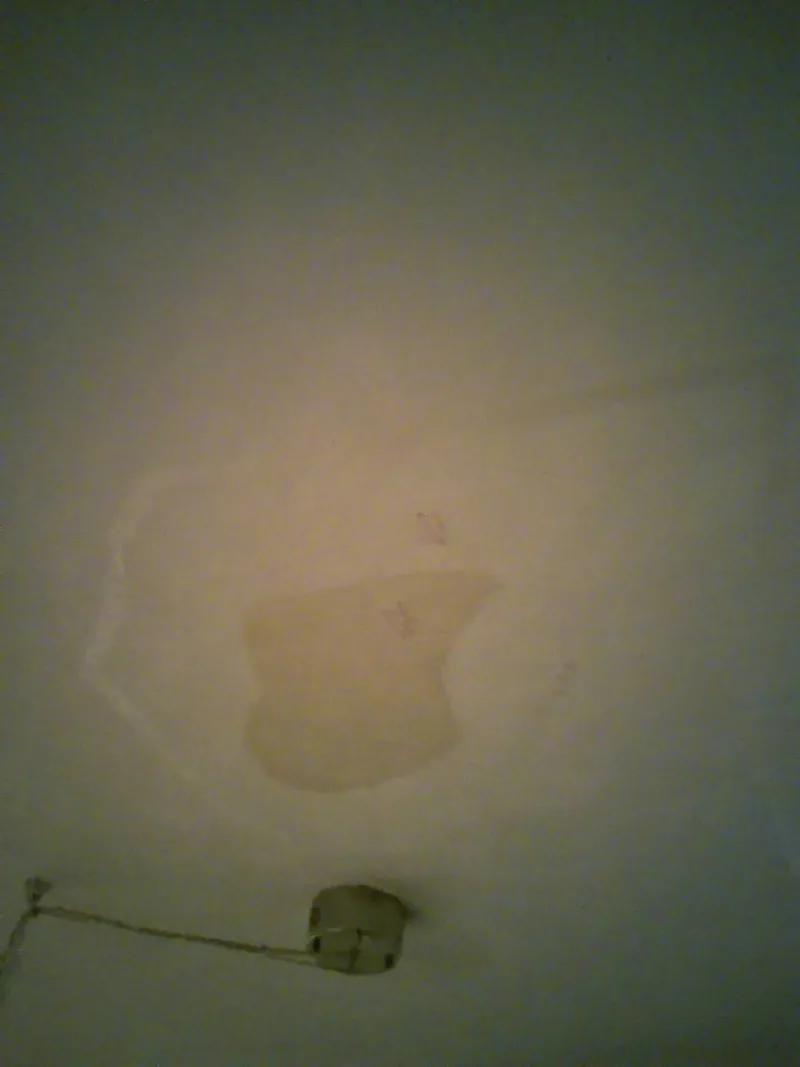
- Home: a townhouse in Toronto.
- What happened: while a bidet seat was being installed on the upstairs toilet, water left in the supply connection spilled onto the bathroom floor. The shut-off valve had been closed first. The water was wiped up, but the floor stayed wet for about two hours.
- Next morning: a stain on the ground-floor ceiling, below the bathroom.
- What the owner asked, in their words: "If there is still moisture and if we need to repair anything outside of cosmetic repair." The next day: "What kind of specialists do we contact?"
That last question is the one most people have. A stain does not tell you whether you need a plumber, a restoration company, a painter, or all three, or in what order.
Two visits, about 24 hours apart
| Check | Visit 1 (the evening of the enquiry) | Visit 2 (next day) |
|---|---|---|
| Thermal imaging | The ceiling below and the bathroom | The same areas |
| Moisture meters | Pinless mapping, with a pin-type cross-check at the baseboard. Wet areas marked with tape and their readings. | The same marked spots re-read, with the bathroom unused in between |
| Fixtures | A flush test with the new bidet connection under observation; tub, vanity and sink cabinet checked | Sink cabinet re-checked |
| Indoor conditions | Three temperature and humidity loggers (below the stain, kitchen, outdoors) | – |
| Borescope | – | Fed through the existing opening under the vanity |
Non-invasive: nothing was opened or cut. The second visit was a one-off courtesy re-check on this job, not part of the standard service. A paid re-read of marked spots is available as a follow-up visit.
Five findings, and how sure we could be
1. The moisture went further than the stain
On the first visit the cool area on the thermal image was larger than the visible stain, and readings just outside the stain were at the top of the meter's scale. Two narrow V-shaped lines led into it; one possible explanation is water running along the top of the drywall before soaking through.
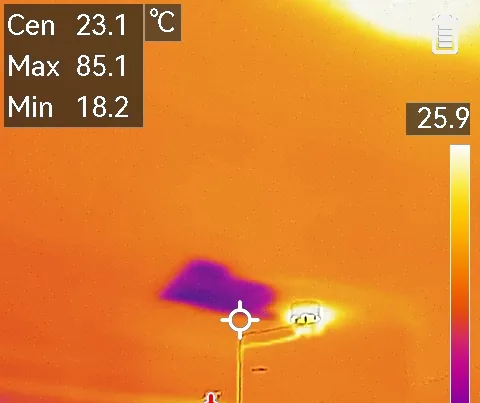
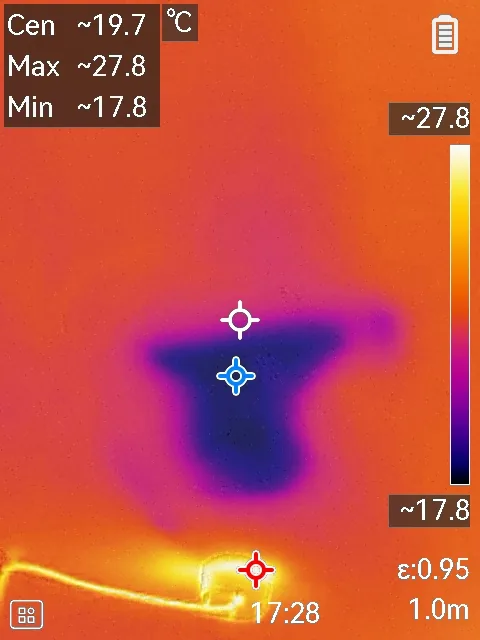
Thermal images are shown as recorded, cropped only. Thermal imaging shows surface temperature, not moisture; the meter readings below are what support the moisture finding.
2. It was drying, but it had not finished
About 24 hours later, with the bathroom unused:
| Spot | Visit 1 | Visit 2 |
|---|---|---|
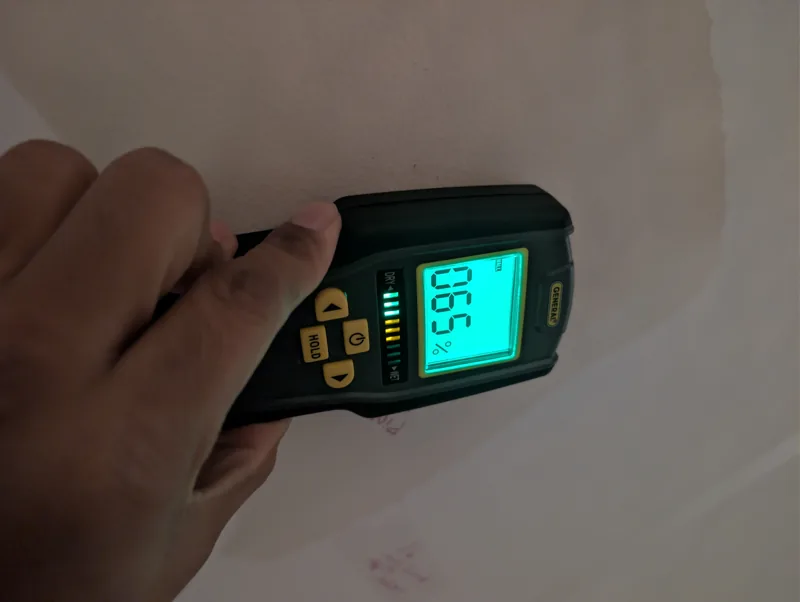
| Inside the ceiling stain | about 100 | 55–65 |
| Just outside the stain | 100 | 0 |
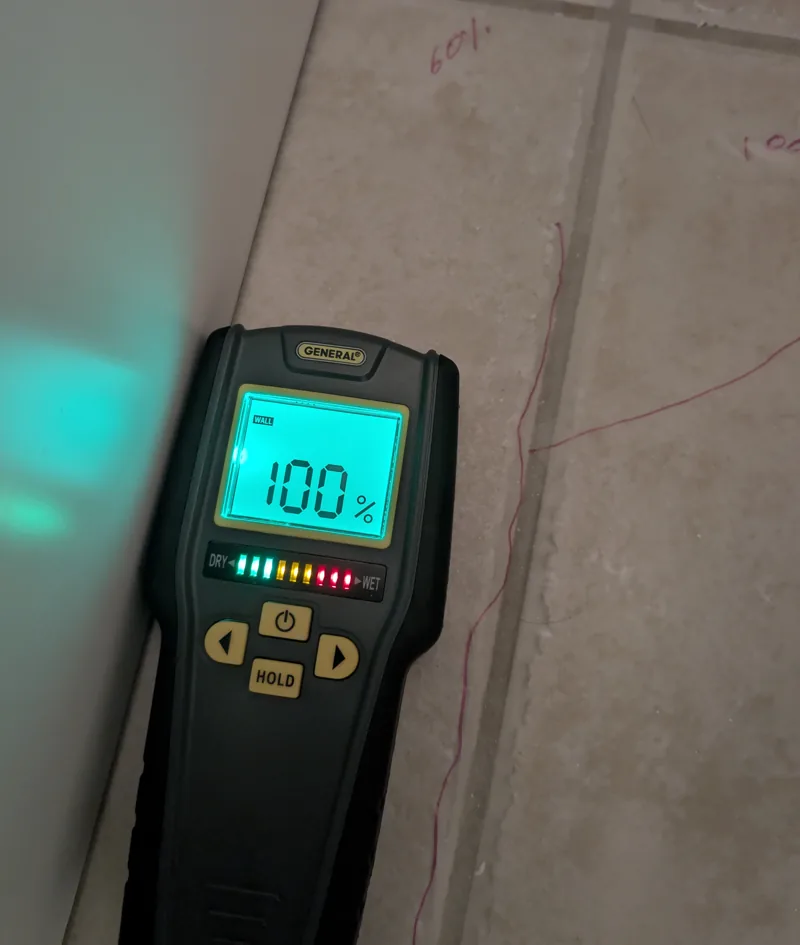
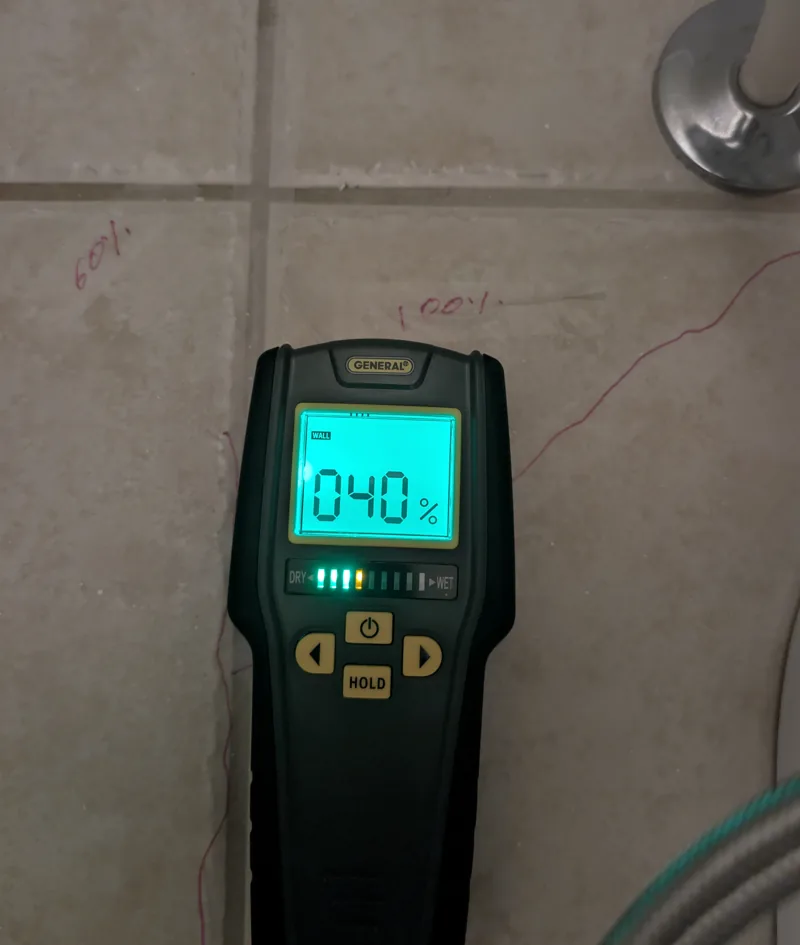
| Bathroom floor, centre of the wet zone | 100 | 40–58 |
| Base of the vanity, toilet side | 100 | 100, still elevated |
| Dry tile elsewhere in the bathroom (reference) | 12–18 | – |
Readings are relative, on the meter's 0–100 scale. They compare wet with dry and show change over time; they are not a percentage of water content.
3. No leak was seen during the flush test
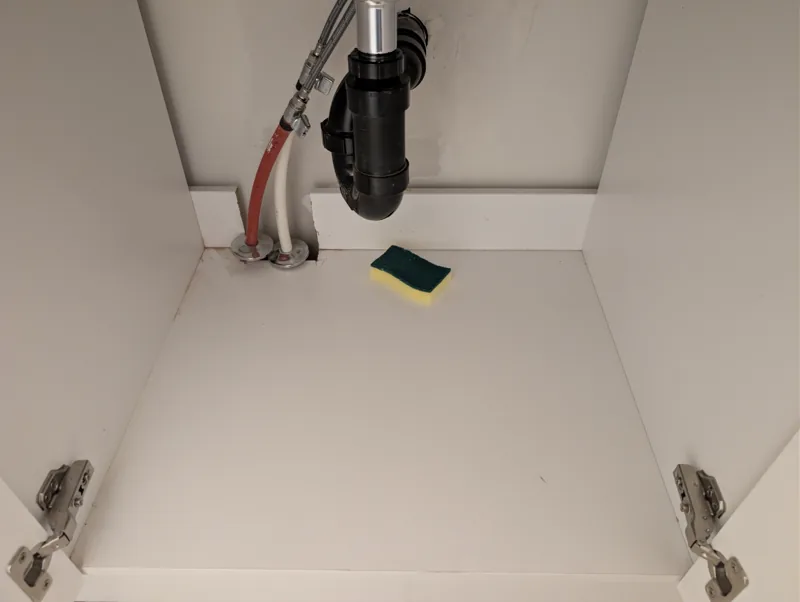
With water flowing through the new bidet connection, nothing leaked at the connection or hose, and the stain and readings did not change. An on-and-off leak cannot be completely ruled out from one test, so a plumber's short check was still recommended.
4. The measured conditions did not support condensation
At 24.6 °C and 37% relative humidity, moisture in the air only condenses on a surface colder than about 9 °C. The coldest point on the stain was 18.1 °C, so room-side condensation did not explain it.
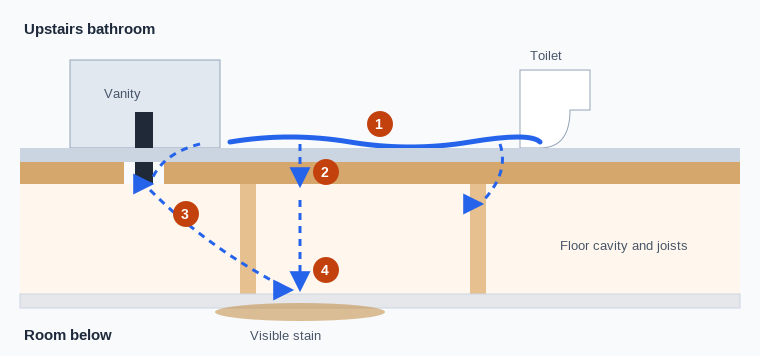
5. The borescope showed an opening: a possible route for the spill
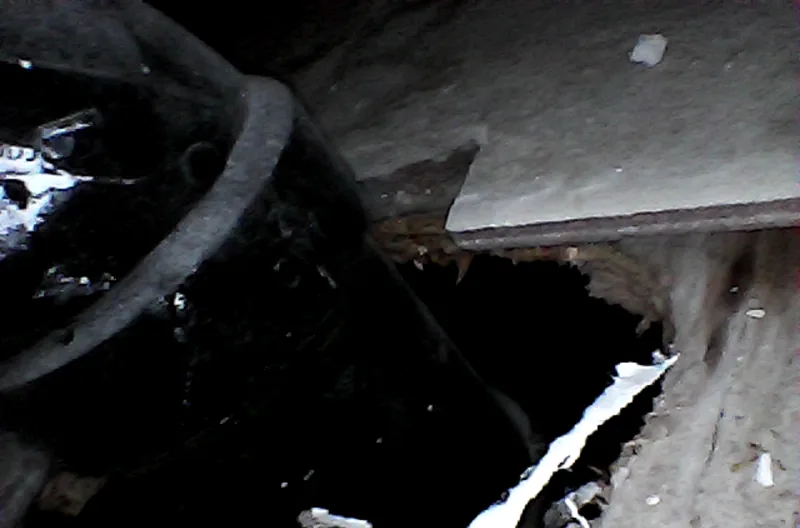
Under the vanity, the drain pipe goes through a rough, oversized cut in the subfloor, with splintered edges and open space on all sides. It sits beside the floor area that stayed wet and above the stained ceiling. The subfloor normally separates the bathroom from the ceiling below; this gap goes straight through it.
| In the report | For this case |
|---|---|
| Observation | An oversized, unsealed hole around the drain pipe, next to the wet floor area and above the stain. |
| Possible explanation | The spill reached the ceiling through this hole and other gaps such as grout lines and the uncaulked edge behind the toilet. |
| Confirmed finding | The hole itself is a defect that needs sealing. That it carried this particular water could only be confirmed by opening the floor or ceiling. |
The order of repairs the owner was given
- Water damage restoration company, this week. Confirm whether the hidden ceiling space and the subfloor are dry, and decide whether an inspection opening or drying is needed.
- Licensed plumber, this week. A short check of the bidet connection, the toilet shut-off valve and the sink drain.
- Seal the gaps, after steps 1 and 2. Ask the contractor to assess sealing the hole around the drain pipe and the missing caulking behind the toilet, so a future spill is less likely to take the same route.
- Prime and paint last, once the ceiling is confirmed dry. Paint can trap moisture and hide warning signs.
The report included what to say to each trade, with the readings and photos they would want, so the owner did not have to explain the problem from the beginning three times.
What the client received: the first two pages of the report
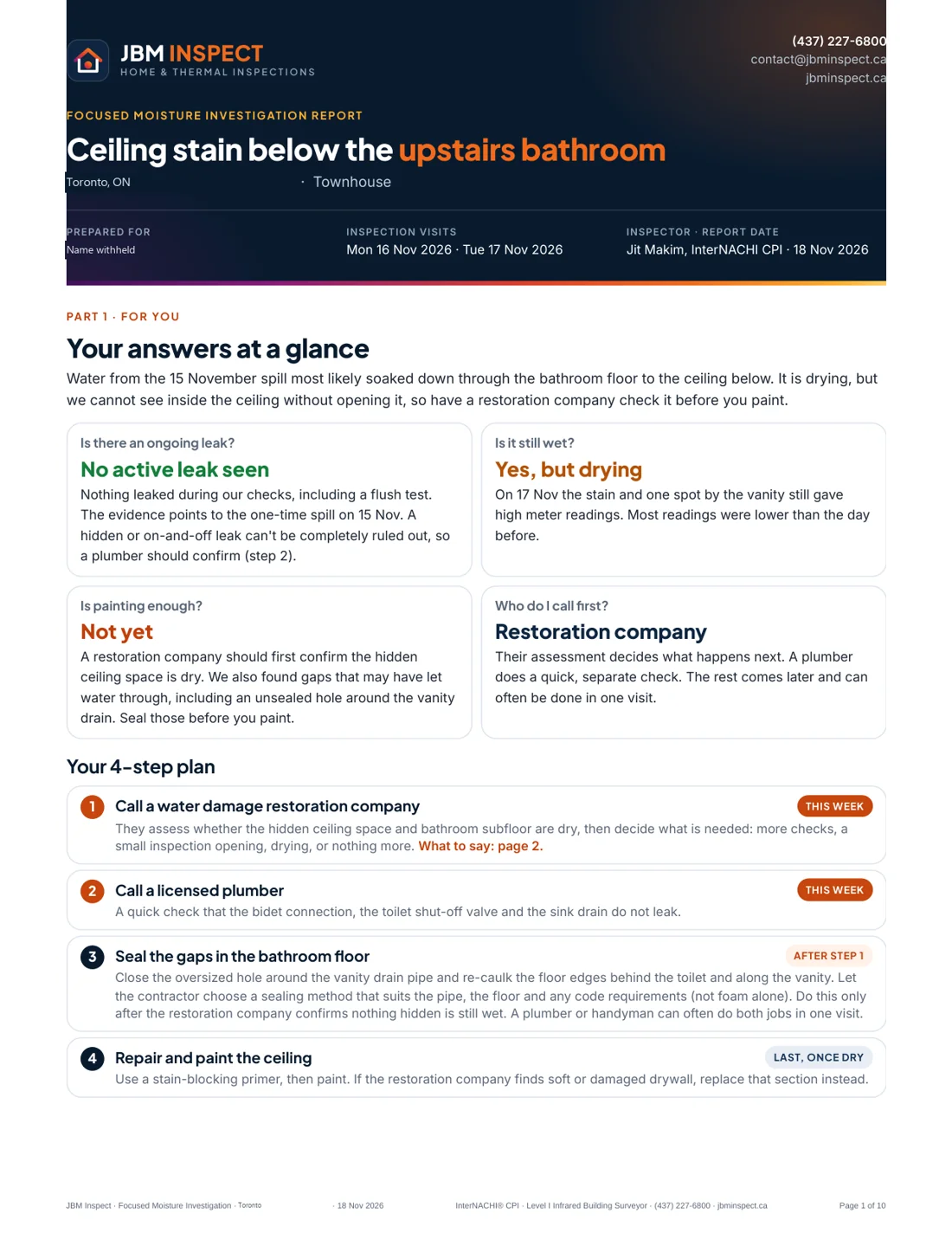
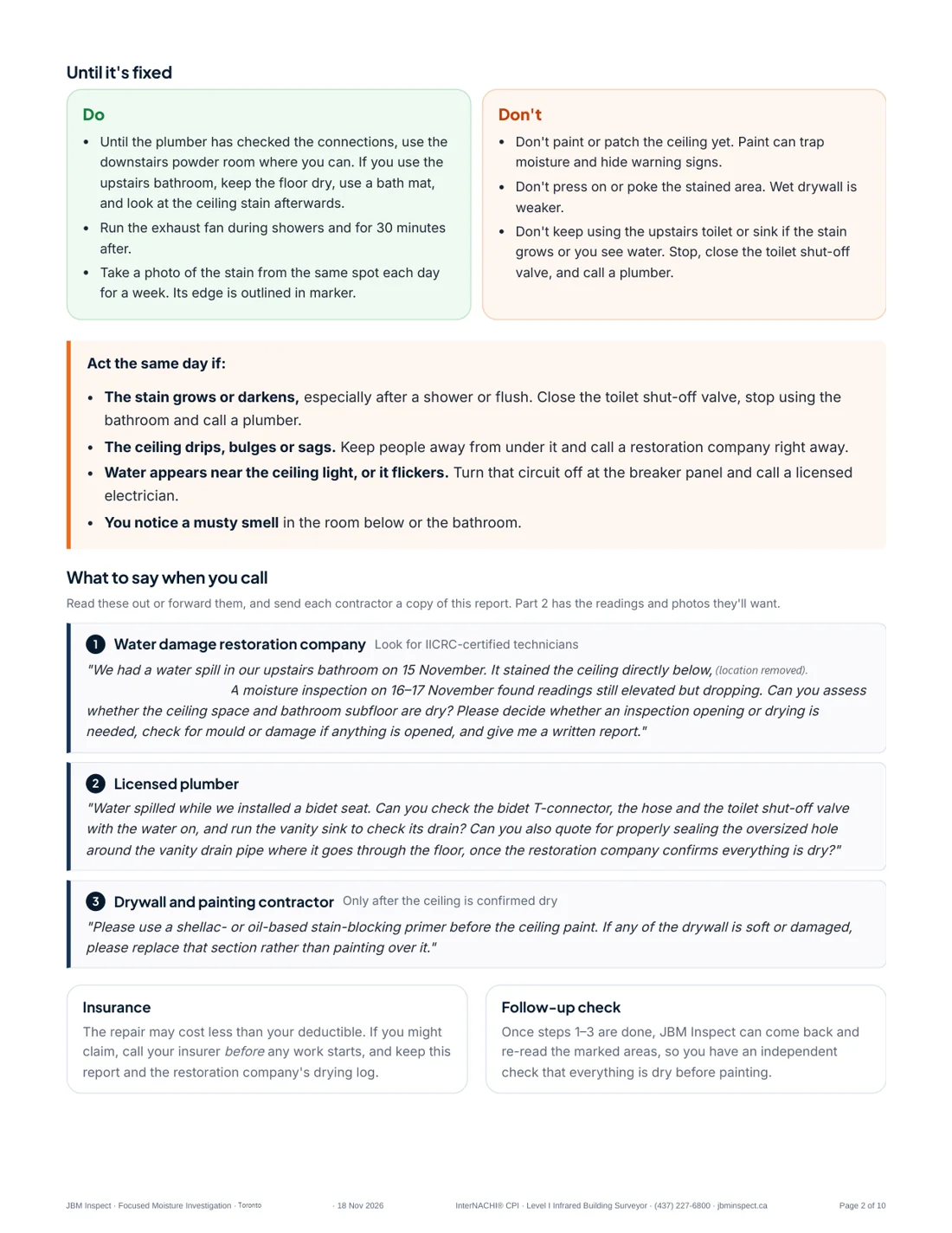
Page one answers the owner's questions and gives the order of work; page two says what to do until it is fixed and what to say to each trade. Address, name and location details are removed; nothing else is changed. The rest of the report has the readings, photos and limitations.
Read these two pages as text
Focused Moisture Investigation report: ceiling stain below the upstairs bathroom. Townhouse, Toronto. Visits Mon 16 and Tue 17 November 2026; report 18 November 2026. Inspector: Jit Makim, InterNACHI CPI.
Page 1: Your answers at a glance
Water from the 15 November spill most likely soaked down through the bathroom floor to the ceiling below. It is drying, but we cannot see inside the ceiling without opening it, so have a restoration company check it before you paint.
- Is there an ongoing leak? No active leak seen. Nothing leaked during our checks, including a flush test. The evidence points to the one-time spill on 15 November. A hidden or on-and-off leak can't be completely ruled out, so a plumber should confirm (step 2).
- Is it still wet? Yes, but drying. On 17 November the stain and one spot by the vanity still gave high meter readings. Most readings were lower than the day before.
- Is painting enough? Not yet. A restoration company should first confirm the hidden ceiling space is dry. We also found gaps that may have let water through, including an unsealed hole around the vanity drain. Seal those before you paint.
- Who do I call first? Restoration company. Their assessment decides what happens next. A plumber does a quick, separate check. The rest comes later and can often be done in one visit.
Your 4-step plan
- Call a water damage restoration company (this week). They assess whether the hidden ceiling space and bathroom subfloor are dry, then decide what is needed: more checks, a small inspection opening, drying, or nothing more.
- Call a licensed plumber (this week). A quick check that the bidet connection, the toilet shut-off valve and the sink drain do not leak.
- Seal the gaps in the bathroom floor (after step 1). Close the oversized hole around the vanity drain pipe and re-caulk the floor edges behind the toilet and along the vanity. Let the contractor choose a sealing method that suits the pipe, the floor and any code requirements (not foam alone). Do this only after the restoration company confirms nothing hidden is still wet.
- Repair and paint the ceiling (last, once dry). Use a stain-blocking primer, then paint. If the restoration company finds soft or damaged drywall, replace that section instead.
Page 2: Until it's fixed
Do: until the plumber has checked the connections, use another bathroom where you can; if you use this one, keep the floor dry, use a bath mat and look at the ceiling stain afterwards. Run the exhaust fan during showers and for 30 minutes after. Photograph the stain from the same spot each day for a week; its edge is outlined in marker.
Don't: paint or patch the ceiling yet (paint can trap moisture and hide warning signs); press on or poke the stained area (wet drywall is weaker); keep using the toilet or sink if the stain grows or you see water (stop, close the toilet shut-off valve and call a plumber).
Act the same day if: the stain grows or darkens, especially after a shower or flush (close the shut-off valve, stop using the bathroom, call a plumber); the ceiling drips, bulges or sags (keep people away from under it, call a restoration company right away); water appears near the ceiling light or it flickers (turn that circuit off at the breaker panel and call a licensed electrician); you notice a musty smell.
What to say when you call (read these out or forward them, with a copy of the report):
- Water damage restoration company (look for IICRC-certified technicians): "We had a water spill in our upstairs bathroom on 15 November. It stained the ceiling directly below. A moisture inspection on 16–17 November found readings still elevated but dropping. Can you assess whether the ceiling space and bathroom subfloor are dry? Please decide whether an inspection opening or drying is needed, check for mould or damage if anything is opened, and give me a written report."
- Licensed plumber: "Water spilled while we installed a bidet seat. Can you check the bidet T-connector, the hose and the toilet shut-off valve with the water on, and run the vanity sink to check its drain? Can you also quote for properly sealing the oversized hole around the vanity drain pipe where it goes through the floor, once the restoration company confirms everything is dry?"
- Drywall and painting contractor (only after the ceiling is confirmed dry): "Please use a shellac- or oil-based stain-blocking primer before the ceiling paint. If any of the drywall is soft or damaged, please replace that section rather than painting over it."
Insurance: the repair may cost less than your deductible. If you might claim, call your insurer before any work starts, and keep this report and the restoration company's drying log. Follow-up check: once steps 1–3 are done, JBM Inspect can come back and re-read the marked areas, so you have an independent check that everything is dry before painting.
| The decision the owner faced | What the evidence supported |
|---|---|
| Paint over the stain once it looks dry? | Not yet: the centre of the stain and one floor spot were still wet. |
| Pay someone to search for a plumbing leak? | No leak was seen; the spill was the most likely cause. A short plumbing check, not a search. |
| Describe the stain to several trades and hope one finds the cause? | One report with readings, photos and a script for each trade. |
| Repair the ceiling and leave the floor as it was? | Seal the hole under the vanity so the next spill does not follow the same path. |
| Who to call first? | Restoration first, plumber second, sealing third, paint last. |
We do not know what the repairs cost or how they turned out, so we make no claim about savings. This page shows the advice the evidence supported.
What this investigation cost, and what it could not show
Focused Moisture Investigation $279, plus a $50 travel charge (this address is more than 40 km by road from our Brampton dispatch point), plus 13% HST: $371.77 in total. Evening start; written report two days later. Within 40 km, which includes all of Brampton, the same visit is $315.27 with HST.
- Non-invasive. The hidden ceiling cavity, framing and subfloor could not be seen or measured, so a restoration contractor was asked to confirm they were dry before cosmetic repairs.
- Limited water testing. The toilet was flushed under observation; the sink, tub and drains were not water-tested.
- Point in time. The findings describe two visits in November 2026. Not a mould assessment and not a full home inspection.
In short: after a bathroom spill stained a Toronto ceiling, two visits a day apart showed the ceiling was drying but not dry, no leak was seen during a flush test, measured conditions did not support condensation, and a borescope showed an unsealed hole around the vanity drain, a possible route for the water. The owner was advised to call a restoration company first, then a plumber, seal the gaps, and paint last.
Questions about this case
Why not just paint over a ceiling stain once it looks dry?
A stain can look dry while the material behind it is still wet. In this case the centre of the stain still read high a day later. Paint can trap moisture and hide warning signs, so drying should be confirmed first.
Why recommend a restoration company and a plumber after paying for an investigation?
Because the investigation showed which of them was needed, for what and in what order. Restoration was asked to confirm the hidden cavity was dry; the plumber was asked for a short check, not an open-ended leak search. JBM Inspect doesn't sell or do repairs, so the advice is not tied to selling the work.
Can a borescope see inside a ceiling?
Only through an opening that already exists. Here it went through the opening the drain pipe already passes through. We do not cut holes; if opening a surface is the only way to confirm something, we say so and name the trade.
Is a second visit included in a moisture investigation?
No. On this job a short re-check the next day was a one-off courtesy. If comparing readings over time would change your next step, a re-read of the marked spots can be booked as a follow-up visit.
Seeing a stain after a leak or spill?
Send a photo and tell us when it appeared. We'll confirm whether a focused moisture investigation fits, and your total price, before you book.